Eight Patterns for Securing AI Agents Like Employees, Not Apps
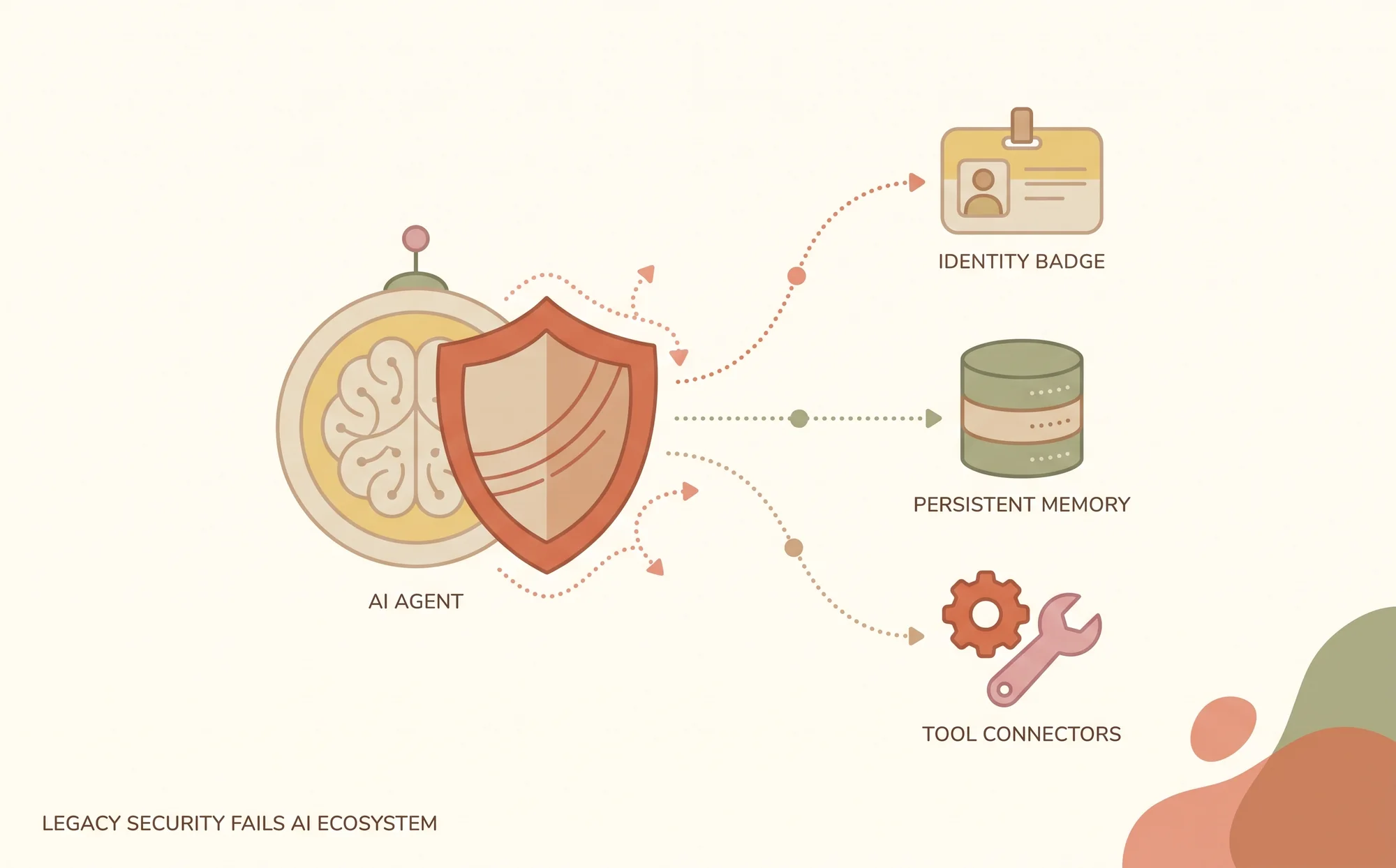
The first post in this series drew the threat model: agents aren't applications, and the controls built for applications (RBAC, prompt filtering, encryption, human approvals, monitoring) leave a blind spot exactly where agents do their most consequential work. They have autonomous identities, persistent memory, and tools that take real actions. The standard stack assumes none of that. Agentic AI security is the work of closing that gap.
This post is the other half: eight patterns that close it. None replace the table-stakes controls; they sit on top, at the layer where autonomy lives. The throughline is one shift in posture — stop modeling an agent as software you deploy, and start modeling it as an employee you hire, manage, budget, and contain when it goes wrong.
1. Treat agents as employees, not applications
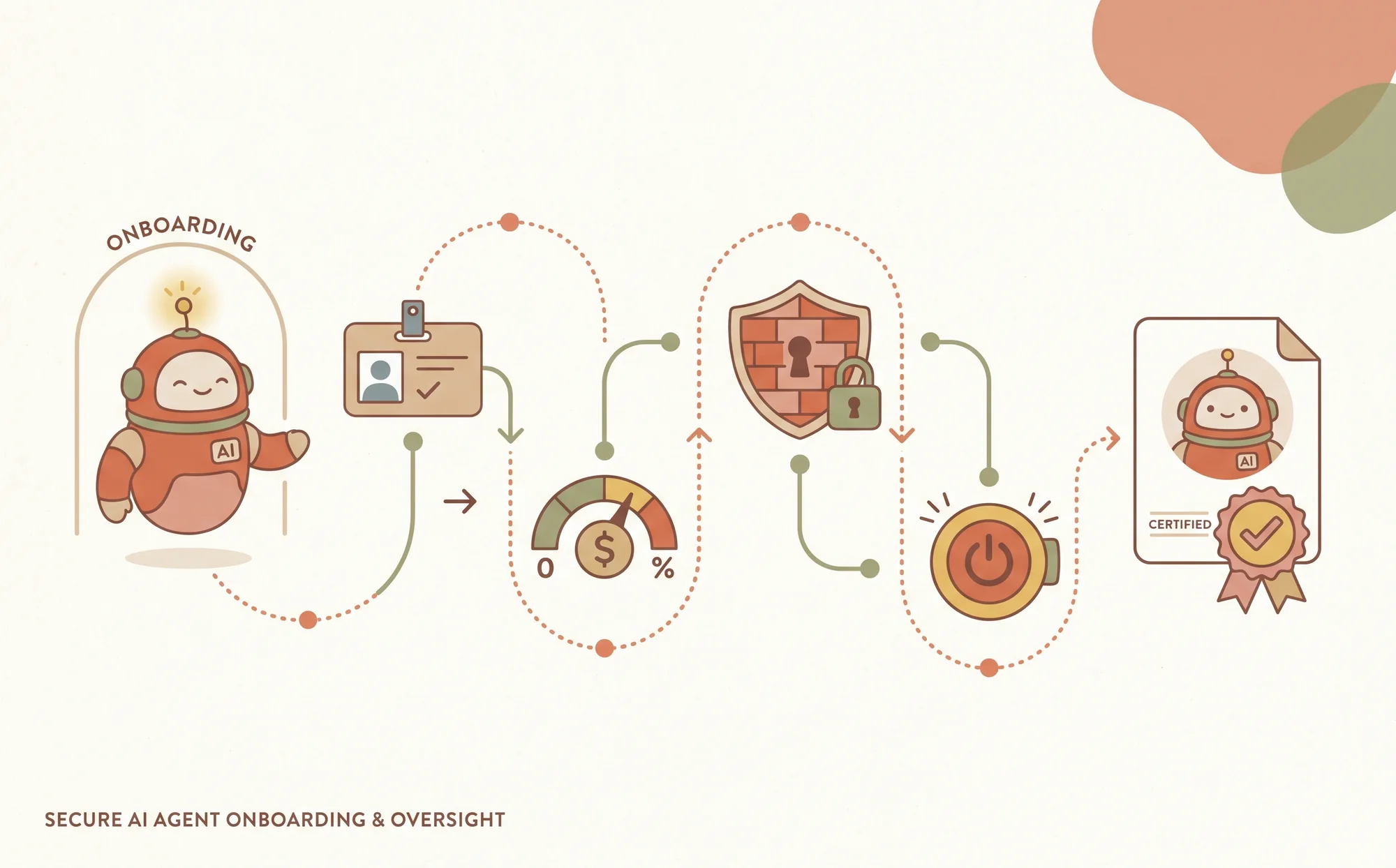
You don't hand a new hire a master key and walk away. You give them a role, objectives, a spending limit, an escalation path, and conditions under which they're let go. Agents need the same scaffolding:
- A job description, what it's for, and what it isn't.
- Performance objectives, measurable, so "working as intended" is something you check.
- Spending limits, on money, on actions, on reach.
- Escalation paths, the moments it must stop and ask a human.
- Termination conditions, the triggers that suspend or retire it.
This answers identity and privilege abuse directly: the right mental model is an intern with narrow, revocable privileges, not a trusted automation you provision once and forget.
2. Put a firewall between the agent and its tools
Most organizations protect the prompt. Very few protect the interaction that actually causes harm: the one between the agent and its tools. The pattern is a pair of checkpoints around every tool call. A tool-input firewall sanitizes what the agent is about to send before the tool runs it. A tool-output firewall inspects what comes back before the agent acts on it. Together they answer tool misuse and unexpected code execution, turning a malicious payload into a logged, blocked attempt.
3. Give every agent a security budget
Hardcoded software stops when it hits its limits. An autonomous agent in a bad loop just keeps going. So give it limits it can actually hit:
- Token budget
- API budget
- Compute budget
- Tool-call budget
- Data-access budget
When any is exceeded, the architecture acts on its own: suspend the agent, require approval, or escalate to a human. This is the circuit breaker against runaway autonomy and cascading failures, and it's the cheapest insurance you'll buy.
4. Build a retrieval security layer
If every agent reads from one shared vector database, you've built a single poisonable surface that touches everything. The pattern is segmentation by role:
- A coding agent sees code.
- A finance agent sees finance documents.
- An HR agent sees HR policies.
Several knowledge bases scoped to who needs what, not one shared well. This contains retrieval poisoning the way network segmentation contains a breach: corrupting one base no longer gives an attacker a lever over agents that were never meant to touch that data. Pair it with provenance on retrieved content, so an agent can weigh where knowledge came from.
5. Run multi-agent systems on zero trust
The dangerous assumption in most multi-agent designs is that agents trust their peers. Drop it. Treat every agent as an untrusted principal, even the ones on your own team:
- Authenticate to other agents with its own identity, not a shared key.
- Validate the requests it receives.
- Verify the outputs it's handed before acting on them.
- Operate with least privilege, so a compromise stays contained.
These are the guarantees we'd consider non-negotiable between two microservices, applied where they're usually absent. It's what neutralizes cross-agent manipulation and rogue agents: a compromised agent can't inject manipulated input into the others.
6. Treat memory as something that can be poisoned
Most teams threat-model the prompt and forget the memory. But memory is where the slow attacks live: the poisoned record that survives across sessions, or the learned pattern that hardens into a rule no one wrote. (The invoice agent that taught itself to auto-approve Customer X's million-dollar invoices, from part one, is this exactly.) Memory that can't be audited can't be trusted, so give it the properties that make it auditable:
- Versioning, so you can see what the agent believed and when.
- Expiry, so stale or unverified "facts" don't live forever.
- Provenance, so every memory traces back to where it came from.
- Trust scores, so the agent weighs its memories instead of treating them as ground truth.
With those in place, a record with no provenance, or a low-trust "fact" driving a high-stakes action, becomes an anomaly you can catch rather than a silent compromise.
7. Design the kill switch before you ship
When an agent goes wrong, the worst time to figure out how to stop it is while it's going wrong. Containment has to be designed in. Every production agent should support, as first-class operations:
- Immediate suspension, halt it now, no graceful shutdown required.
- Credential revocation, cut its access to tools and data instantly.
- Memory purge, wipe poisoned or compromised memory.
- Tool disconnect, sever its ability to take further action.
- Rollback, undo recent actions where the domain allows it.
This turns a rogue agent from a crisis into a button. It's also the one almost nobody builds upfront, so build it in the design phase, not after the first incident.
8. Certify agents in a security digital twin
We'd never promote code straight from a laptop to production. We routinely promote agents that way. The fix is a staging environment built for agents: a mirror of production that's safe to break, with synthetic customers, repositories, databases, and APIs. Run agents there first and measure the things only autonomy produces:
- Unsafe action rate
- Privilege-escalation attempts
- Hallucinated actions
- Tool misuse
Only agents that pass certification get promoted. It turns "we think it's safe" into a number you measured, before a real customer pays for the failure modes.
What agentic AI security actually secures
Read the patterns together and the posture is clear. We're not securing a model. We're securing a workforce. The teams that get this right won't stop at the model's outputs. They'll secure agent behavior, agent memory, agent collaboration, and agent decision-making itself, because that's where the risk actually lives.
None of it requires waiting for a standard to mature. The threat model is already documented, the patterns are buildable today, and the teams that treat agentic AI security as a design problem now will be the ones still standing when the first wave of agentic incidents makes the news.
At Atharvix, agentic AI security is the layer we spend the most time on, because in production an agent's security model and its architecture are the same thing. If you're designing agent-driven workflows and want to build these patterns in from the start rather than retrofit them after an incident, talk to our team.