AI Balance Sheets: The Essential AI Governance Framework for Risk and Asset Management
We meticulously track every dollar of capital expenditure and every line of technical debt, yet most organizations have zero visibility into their largest emerging asset class—the accumulated intelligence of their AI systems. More alarmingly, they are blind to their fastest-growing liability category: the silent, compounding risks those same systems generate daily. This isn't just an oversight; it's a fundamental failure of corporate governance that renders our current AI risk management strategies obsolete. If you cannot measure your cognitive liabilities, you cannot responsibly deploy AI agents at scale.
The race to deploy generative AI has created a dangerous illusion of progress. We celebrate the productivity gains—the automated reports, the accelerated code generation, the instant customer service responses—as unalloyed victories. A recent report from Gartner predicts that over 80% of enterprises will have used generative AI APIs or deployed GenAI-enabled applications by 2026. This frantic adoption is understandable, but it's built on a dangerously incomplete accounting. We are enthusiastically booking the assets on one side of the ledger while completely ignoring the corresponding liabilities accumulating on the other. This one-sided view is setting the stage for a new kind of systemic failure, one born not of financial miscalculation, but of cognitive insolvency.
Beyond Productivity: The Hidden Risks of Ungoverned AI
The prevailing wisdom treats AI deployment as a straightforward technology implementation, measured by efficiency gains and cost reduction. The status quo is to launch pilot programs, demonstrate a positive ROI on a narrow task, and then greenlight wider deployment. We measure success in hours saved or tickets closed, metrics that feel concrete but tell a dangerously incomplete story. This approach is insufficient because it mistakes activity for value and fails to price in the complex, latent risks inherent in autonomous systems.
The emerging signals of this imbalance are already visible. A working paper from the National Bureau of Economic Research found that while AI adoption boosts productivity, it also correlates with an increase in operational "black swan" events—unpredictable, high-impact failures. We see this in headlines about AI chatbots fabricating legal precedents or sophisticated data leakage incidents that bypass traditional security. These are not isolated bugs; they are symptoms of a system where the liabilities are unmanaged, unmeasured, and therefore, unbounded. The primary blind spot for most leaders is the failure to recognize that every new AI capability deployed is a dual-entry transaction. It creates an asset, but it also creates a corresponding liability.
What is the AI Balance Sheet? A New Framework for Cognitive Accounting
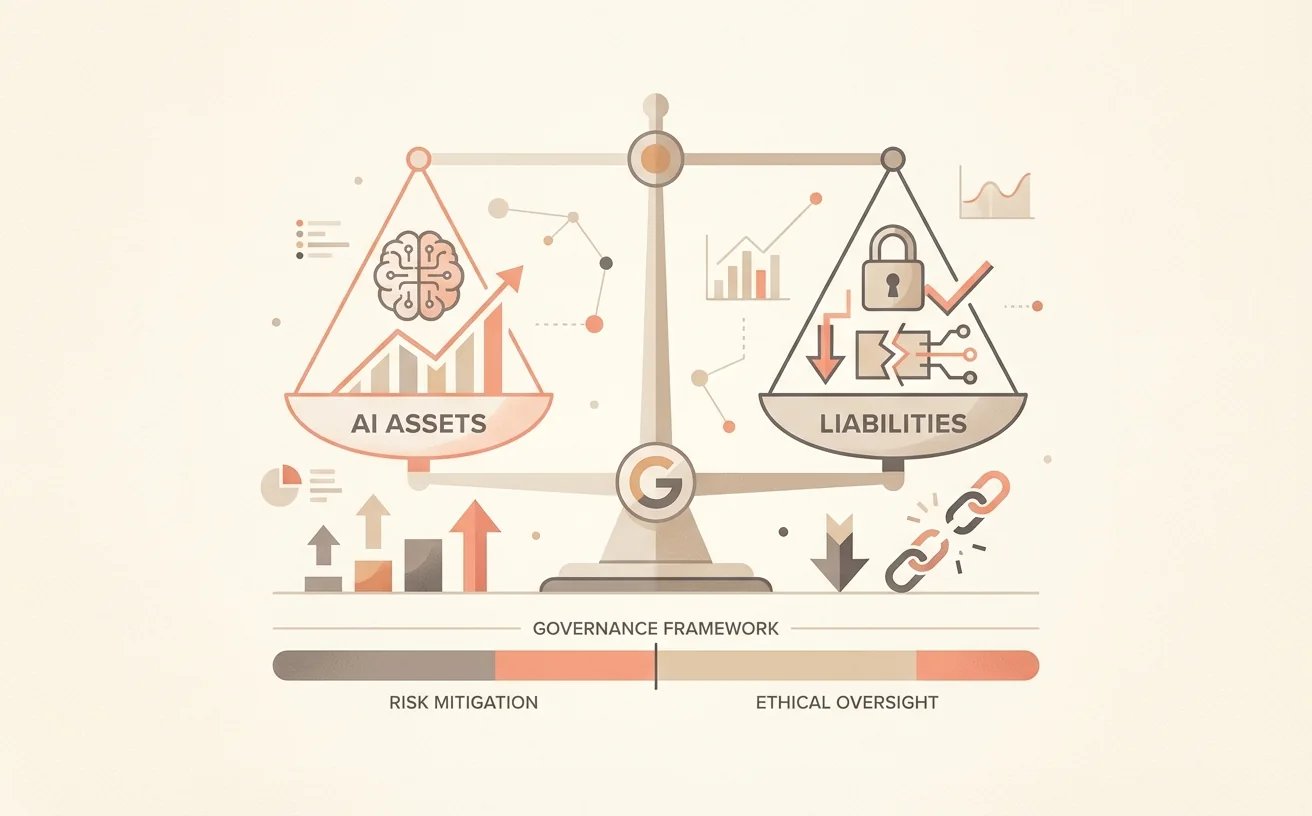
To navigate this new reality, we must move beyond the limited vocabulary of IT project management and adopt the rigorous discipline of financial accounting. The most effective way to conceptualize this is through a new governance tool: the AI Balance Sheet. This is not a literal financial document but a strategic framework for identifying, measuring, and managing the two sides of AI's impact on the enterprise: cognitive assets and cognitive liabilities. It is one of the most critical AI governance frameworks a modern enterprise can adopt.
The core argument is this: Organizations deploying AI agents are accumulating valuable cognitive assets—trained workflows, institutional memory embedded in models, validated automations, and compounding AI operational intelligence. Simultaneously, they are taking on significant cognitive liabilities: hallucination risk in AI models, new data leakage vectors, mounting automation debt from brittle integrations, and a portfolio of unaudited agent decisions that create hidden compliance gaps. Until companies build an AI Balance Sheet that tracks both sides with equal rigor, they cannot achieve effective AI financial governance.
This framework draws a crucial connection from finance, specifically double-entry bookkeeping. For over 500 years, this system has ensured that for every asset, there is a corresponding claim against it (a liability or equity). We must apply this same logic to AI. The deployment of an AI agent that automates financial analysis is a cognitive asset. The corresponding liability is the quantifiable risk of a hallucinated data point in its output influencing a multi-million-dollar decision. This is the foundation of cognitive assets management.
The Anatomy of Cognitive Assets and Liabilities
Cognitive Assets are the intangible, AI-driven capabilities that create enterprise value. Effective cognitive assets management involves tracking:
- Proprietary Workflows: Unique, multi-step processes automated by agents that represent a competitive moat.
- Trained Institutional Knowledge: The distilled expertise of your best performers, encoded into fine-tuned models to build institutional memory with AI.
- Validated Automation Chains: Interconnected agent tasks that reliably execute complex business operations.
- Compounding AI Operational Intelligence: The network effect of interconnected AI systems that learn from each other and enterprise data, improving over time.
Cognitive Liabilities, conversely, are the hidden risks and debts incurred through AI deployment. They are the invisible "dark matter" of an organization's risk universe; their gravitational pull is felt in operational disruptions, but they are not directly observable without the right instruments. These include:
- Model Risk Exposure: The aggregated probability of financial or reputational damage from model hallucinations, bias, or drift, representing the core of hallucination risk in AI.
- Data Privacy Vectors: The potential for sensitive data to be exposed through model training, inference, or insecure agent integrations.
- Automation Debt: The future cost of maintaining, refactoring, or decommissioning brittle, poorly documented AI integrations. Finding effective automation debt solutions is critical for long-term health.
- Unaudited Decision Ledgers: The accumulated record of autonomous agent decisions that have not been logged or checked against regulatory requirements, creating a latent compliance crisis.
The organizations that master this form of cognitive accounting will deploy agents with confidence; the rest will oscillate between reckless deployment and paralytic caution.
How to Build Your AI Balance Sheet: A 3-Step Guide
Implementing this framework requires a deliberate, structured approach. It is not merely a technical exercise but a strategic imperative that bridges technology, finance, and risk management.
Step 1: Catalog and Classify Your AI Assets
The first step is to create a comprehensive inventory of all AI systems and agents operating within the organization. This goes beyond a simple list of software. For each agent, you must document its function, the data it accesses, its decisions, and its dependencies on other systems.
- Action: Establish a central AI Agent Registry. This registry should catalog each model's purpose, training data lineage, and operational scope.
- Criticality: This foundational step provides the basic visibility required for any form of governance. As a recent analysis by Deloitte's AI Institute highlights, over 60% of organizations lack a comprehensive inventory of their AI models, rendering effective risk management impossible.
- Mistake to Avoid: Do not treat this as a one-time project. The registry must be a living document, continuously updated as new agents are deployed and existing ones are modified.
Step 2: Quantify and Value Assets and Liabilities
This is the most challenging and most critical step. It requires moving from qualitative descriptions to quantitative metrics, a process that necessitates interdisciplinary expertise and forms the core of your AI risk management strategies.
- Implementation: To value cognitive assets, we can adapt methodologies from intellectual property valuation, assessing the replacement cost or income-generating potential of a proprietary AI workflow. For cognitive liabilities, we must turn to insurance actuarial science. By analyzing the probability and potential impact of events like model hallucination or data leakage, we can assign a quantifiable risk exposure value, much like an underwriter prices a policy. A study from the Stanford Institute for Human-Centered AI provides frameworks for modeling the financial impact of algorithmic bias, offering a template for this kind of quantification.
- Resources Needed: This demands a new kind of team—a coalition of data scientists, financial analysts, and risk managers who can build and validate these valuation models.
- Challenges: The primary challenge is the uncertainty inherent in predicting AI behavior. The solution is not to seek perfect precision but to establish defensible, risk-adjusted valuations that can guide strategic decision-making.
Step 3: Integrate and Govern Continuously
The final step is to embed the AI Balance Sheet into the core operational and financial governance structures of the organization.
- Measurement: Develop a C-suite dashboard that reports on the net "Cognitive Equity" (Cognitive Assets minus Cognitive Liabilities). Track key metrics like "Risk-Adjusted Automation Value" and "Total Hallucination Exposure." According to research in the MIT Sloan Management Review, firms that integrate AI metrics into executive dashboards are three times more likely to achieve significant financial benefits from their AI investments.
- Timeline: Organizations should aim to have a preliminary AI Balance Sheet in place within 12 months. The goal is not perfection, but a functional model that brings visibility to these new forces.
- Continuous Improvement: This framework should be reviewed quarterly, alongside traditional financial statements. The insights should inform AI development priorities, decommissioning decisions, and investments in risk mitigation, like exploring new [enterprise data security protocols].
The Future of Corporate Governance: Cognitive Diligence and AI Balance Sheets
The adoption of the AI Balance Sheet will not be optional for long. We are on the cusp of a profound shift in how the market evaluates and trusts corporations. I predict that within three years, auditors will require cognitive asset and liability disclosures alongside traditional financial statements, viewing them as essential to a fair representation of an enterprise's condition.
Furthermore, the insurance industry will become a primary driver of adoption. Underwriters, facing a surge in claims from AI-related failures, will demand AI Balance Sheet visibility before issuing cyber and operational risk policies. Companies with a clear, well-managed cognitive ledger will secure better terms, while those without one will face prohibitive premiums or be denied coverage altogether. Finally, investors and capital markets will begin to price this in. Analysts will value companies partly on the maturity and defensibility of their cognitive assets portfolio, recognizing it as a key indicator of future growth and resilience. The ability to articulate your AI strategy in the language of assets and liabilities will become a prerequisite for securing capital.
The competitive landscape will be redrawn. Winners will be the organizations that treat their AI operational intelligence not as a series of isolated IT projects, but as a core component of their enterprise value, managed with the same discipline they apply to their capital. The losers will be those who continue to chase productivity gains while allowing their unmanaged cognitive liabilities to fester, like geological faults beneath a skyscraper, silent until the moment of catastrophic failure.
Conclusion: Leading the Cognitive Revolution
We stand at a pivotal moment. The current approach to AI deployment—focused exclusively on productivity gains—is a reckless gamble with an organization's long-term health. It is an accounting model that ignores half of the equation, creating a bubble of perceived value that is unsupported by a rigorous understanding of the associated risks.
The AI Balance Sheet offers a path forward—a synthesis of technological insight and financial discipline that provides the holistic view necessary for sustainable innovation. It transforms the abstract concepts of AI capability and risk into a tangible framework for governance, strategy, and value creation.
Your key takeaways should be:
- Every AI deployment creates both a cognitive asset and a corresponding cognitive liability. Ignoring the latter is a critical governance failure.
- The AI Balance Sheet is a necessary framework for measuring and managing this new value-risk paradigm, drawing on principles from finance and actuarial science.
- Mastering AI financial governance is not a defensive compliance exercise; it is the foundation for building a durable competitive advantage in the age of autonomous enterprise.
The first step for every leader is to ask a simple question at their next strategy meeting: "What are our most valuable cognitive assets, what are our largest cognitive liabilities, and how do we know?" The journey to answer that question is the beginning of true leadership in the AI era.
AI · Governance · Risk Management · Enterprise Strategy · AI Ethics