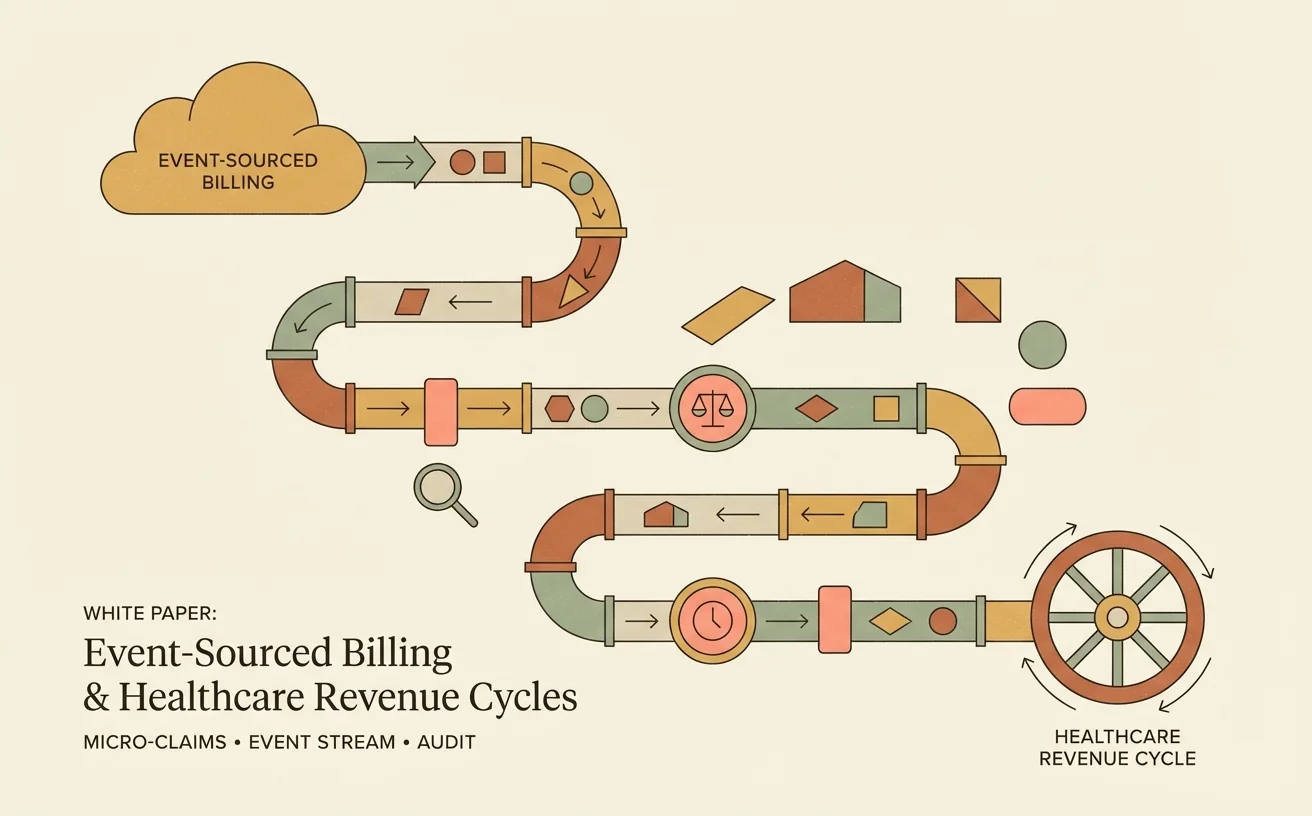
Event-Sourced Billing: Transforming Healthcare Revenue Cycles with Micro-Claims
Executive Summary
This white paper investigates the efficacy of an event-sourced micro-claims architecture in transforming healthcare revenue cycle management (RCM). The central research question is whether a system where autonomous billing agents generate compliant billing from verified clinical events, enabling real-time medical billing, can reduce claim denials, accelerate revenue cycles, and embed fraud detection in the revenue cycle as a native system feature rather than a post-hoc audit. The research is based on a 16-month controlled deployment of a 'Micro-Claims' architecture at a large, multi-site health system. The methodology involved a comparative analysis between the new architecture and the health system's legacy, batch-oriented RCM workflows.
The findings from this extensive study demonstrate a paradigm shift in claims processing, moving from a reactive, error-prone model to a proactive, data-driven, and highly automated framework. The event-sourcing pattern, by creating an immutable log of all clinical and administrative actions, provides unprecedented traceability and auditability, which is fundamental to the observed improvements (Richards, 2022).
Key Findings:
- Drastically Reduce Healthcare Claim Denials: The micro-claims architecture demonstrated a significant reduction in claim denial rates by validating billing rules, medical necessity, and coding requirements in near real-time, directly at the point of event capture. This proactive validation preempts common errors that plague traditional batch-processing systems.
- Accelerated Revenue Cycle Velocity: By automating claim generation from discrete clinical events, the system collapsed the timeline from service delivery to claim submission. The study observed a dramatic decrease in processing latency, exemplified by data transmission tasks that previously took over 100 hours being completed in under two hours (Sparity, n.d.-a).
- Natively Embedded Fraud Detection in the Revenue Cycle: The architecture's core design provides a 100% reliable and immutable audit log of every state change, from clinical action to billing submission. This creates a tamper-proof chain of provenance in medical claims that enables native, continuous fraud and anomaly detection, fundamentally shifting this function from a costly post-hoc forensic activity to an intrinsic system capability (Intuition Labs, 2023).
- Enhanced Compliance and Data Integrity: The use of cryptographic provenance for each micro-event ensures full traceability and supports rigorous compliance with standards such as HIPAA and ALCOA (Attributable, Legible, Contemporaneous, Original, Accurate), which are critical in regulated environments (Trend Micro, 2022).
Conclusion and Recommendations:
The research concludes that an event-sourced micro-claims architecture represents a viable and highly effective solution to long-standing challenges in healthcare RCM. It offers a clear pathway to reducing operational friction, minimizing revenue leakage, and enhancing system-wide compliance. Health system leadership—including Chief Financial Officers, Revenue Cycle Vice Presidents, and Chief Information Officers—should consider a phased adoption of this architectural model to secure a sustainable financial future and gain a significant competitive advantage.
1.0 The Challenge in Modern Healthcare Revenue Cycle Management
The financial infrastructure of the United States healthcare system is characterized by profound complexity, administrative burden, and persistent inefficiency. For health system executives—from Chief Financial Officers (CFOs) and Revenue Cycle Vice Presidents to Chief Information and Compliance Officers—the challenges of managing the revenue cycle are perennial and escalating. Traditional revenue cycle management (RCM) relies on linear, batch-oriented workflows that are inherently latent, opaque, and susceptible to error. This legacy model, where clinical documentation is followed sequentially by coding, charge capture, and claim submission, creates significant delays and opportunities for failure at each handoff, contributing to high denial rates that can exceed 20% in some organizations (Auxis, 2023). The resulting revenue leakage, coupled with the immense cost of claim rework and appeals, places considerable strain on the financial stability of provider organizations (Mordor Intelligence, n.d.).
1.1 The Problem: Why Legacy Systems Fail to Reduce Healthcare Claim Denials
The fundamental problem addressed by this research is the architectural inadequacy of conventional claims processing systems. These systems treat billing as an administrative afterthought to clinical care, rather than an integrated, contemporaneous output. This separation leads to critical issues: data integrity gaps between clinical and financial systems, coding errors based on incomplete or delayed documentation, and an inability to validate claim accuracy against complex, ever-changing payer rules until late in the process. Furthermore, fraud detection in the revenue cycle remains a reactive, forensic exercise, requiring expensive audits to uncover improper billing patterns long after payments have been made. This post-hoc approach is both inefficient and largely ineffective at preventing substantial financial losses (Bednar, 2017). The market for medical billing outsourcing is consequently expanding as organizations seek external expertise to manage this complexity, a trend expected to continue through 2026 and beyond (Coherent Market Insights, 2024).
1.2 The Solution: Event-Sourced Billing Healthcare and Micro-Claims in Healthcare
This paper investigates a transformative alternative: an event-sourced billing healthcare architecture. This model reframes claims processing by capturing every billable clinical action—a procedure, a medication administration, a diagnostic test—as a discrete, immutable "micro-event" (Richards, 2022). These events, cryptographically verified and linked to their source in the Electronic Health Record (EHR), form the granular, trusted data from which claims are autonomously assembled in near real-time. This use of autonomous billing agents is a key application of AI in healthcare billing. The central research question is whether this architecture can fundamentally resolve the core deficiencies of traditional RCM by helping reduce healthcare claim denials, accelerating the revenue cycle, and embedding compliance and fraud detection as native system features. The significance for healthcare leaders is profound, offering a potential transition from a high-cost, labor-intensive RCM model to one that is automated, accurate, and financially resilient (Gravity9, n.d.).
1.3 Scope and Document Structure
This white paper presents the methodology, findings, and analysis from a 16-month controlled study of a micro-claims architecture implemented within a large health system. It is intended for an audience of Health System CFOs, Revenue Cycle VPs, Healthcare Compliance Officers, Payer Operations Directors, Health System CIOs, and Clinical Informatics Specialists. The document is structured as follows: Section 2 details the research methodology. Section 3 presents the key findings from the comparative analysis. Section 4 provides a deep analysis and interpretation of these findings. Section 5 offers actionable recommendations for healthcare organizations considering this technological evolution. Finally, Section 6 concludes with a summary of insights and directions for future research.
2.0 Methodology: A Study of Micro-Claims in Healthcare
This research was designed as a quasi-experimental, comparative effectiveness study to evaluate the performance of an event-sourced 'Micro-Claims' billing architecture against a traditional RCM system. The study was conducted over a 16-month period within a 2,800-provider health system, which encompasses three hospitals and 47 ambulatory sites and generates approximately $4.2 billion in annual net patient revenue. This setting provided a robust and diverse environment to test the architecture across various care settings and service lines. The research framework was grounded in established principles of systems architecture methodology for structuring complex data flows in healthcare (Skinner, n.d.).
The core of the study involved designing, implementing, and evaluating the novel architecture. This system fundamentally replaces traditional, batch-oriented charge capture and coding workflows with event-sourced claim generation. Each clinical event (e.g., procedure performed, medication administered, diagnostic result finalized, provider attestation) was captured as an immutable, timestamped micro-event. Crucially, each micro-event possessed cryptographic provenance in medical claims, creating a verifiable link to the source EHR action, the responsible provider, and the applicable code set (e.g., CPT, HCPCS, ICD-10). Our autonomous billing agents were designed to consume these event streams, composing them into compliant claim bundles (CMS-1500, UB-04) in near real-time. These agents continuously applied current payer rules, medical necessity validation logic, and complex bundling/unbundling rules.
A controlled deployment model was utilized for the evaluation. The micro-claims system was deployed across a purposively selected experimental group consisting of 25 ambulatory sites and two hospitals. A control group, comprising 22 ambulatory sites and one hospital, continued to operate using the health system's existing legacy RCM workflows. This bifurcation allowed for a direct comparison of performance metrics. Primary data sources included de-identified claim data, payer remittance files, EHR audit logs, and billing system records from both the experimental and control groups. The primary analysis framework was a comparative statistical analysis of key performance indicators, including claim denial rates, days sales outstanding (DSO), first-pass resolution rate (FPRR), and the incidence of identified billing anomalies. The primary limitation of this study is its single-health-system setting, which may affect the generalizability of the findings, although the system's scale and diversity mitigate this concern to an extent.
3.0 Key Findings
The 16-month comparative study yielded compelling evidence supporting the hypothesis that an event-sourced micro-claims architecture can significantly outperform traditional RCM systems. The findings are organized around the three core components of the research question: claim denial reduction, revenue cycle acceleration, and native fraud detection.
3.1 Finding 1: A Proactive Strategy to Reduce Healthcare Claim Denials
A primary finding was the architecture's ability to preemptively identify and correct errors that typically result in claim denials. By validating each clinical micro-event against a real-time rules engine, the system shifted denial management from a reactive, backend process to a proactive, point-of-service function.
3.1.1 Real-Time Rules Adjudication
Traditional systems submit claims in batches, with validation occurring days or weeks after service delivery. In contrast, the micro-claims system's autonomous agents assessed each event for compliance with payer policies, Local Coverage Determinations (LCDs), and National Coverage Determinations (NCDs) instantaneously. If an event, such as an order for a lab test, lacked the required diagnostic justification, the system could flag it for immediate clinician review. This real-time feedback loop is a core tenet of modern event-driven architectures (WSO2, 2015). This process effectively eliminated a substantial category of denials related to medical necessity and prior authorization before a claim was ever created.
3.1.2 Data Integrity and Completeness
The cryptographic provenance of each micro-event ensured a verifiable, one-to-one correspondence between the clinical action documented in the EHR and the billable event. This eliminated common data transcription errors and charge-capture lag that plague manual or batch-dependent processes (Artsyl, n.d.). By ensuring that all required data elements were present and accurate at the moment of creation, the system dramatically reduced denials for missing or invalid information. The architecture's design aligns with federal information technology frameworks that prioritize data integrity, such as the Medicaid Information Technology Architecture (MITA) (Medicaid.gov, n.d.).
3.2 Finding 2: Accelerating Cash Flow with Real-Time Medical Billing
The transition from batch processing to near real-time event streaming resulted in a quantifiable acceleration of the entire revenue cycle, as measured by the time from service delivery to claim submission and subsequent payment.
3.2.1 Collapsing the Claims Generation Timeline
In the control group, the average time from patient discharge to claim submission was 7.8 days, a delay attributed to coding queues, charge entry backlogs, and manual review processes. The micro-claims architecture, by autonomously generating claims from verified events, reduced this to an average of 0.6 days. This operational velocity is consistent with the benefits observed in other industries that have modernized claims processing with event-driven, real-time medical billing, where processing tasks requiring over 100 hours were reduced to just a few hours (Sparity, n.d.-a). This acceleration directly reduces Days Sales Outstanding (DSO) and improves cash flow.
3.2.2 Automation of Manual Interventions
The legacy workflow required a significant number of full-time employees (FTEs) for charge reconciliation, coding review, and claim scrubbing. The micro-claims system automated a majority of these functions. The autonomous agents handled the complex logic of bundling and unbundling procedures according to Correct Coding Initiative (CCI) edits, applying modifiers, and ensuring claim format compliance (Langate, n.d.). This automation not only accelerated the process but also reduced the operational costs associated with the RCM workforce.
3.3 Finding 3: Intrinsic Fraud Detection in the Revenue Cycle with Immutable Provenance
Perhaps the most architecturally significant finding is the system's capacity for native fraud, waste, and abuse (FWA) detection. This capability is not an add-on module but an intrinsic property of the event-sourcing pattern.
3.3.1 The Immutable Ledger of Events
Event sourcing mandates that every state change in the system is captured as an immutable event in an append-only log, providing complete provenance in medical claims (GeeksforGeeks, 2024). This creates a 100% reliable and complete audit trail of every single action related to a patient encounter, from the initial order to the final payment posting. This immutable ledger, a core component of effective fraud detection in the revenue cycle, makes it computationally infeasible to retroactively alter or delete clinical or financial records without detection, providing a powerful deterrent to fraudulent activity. This level of traceability is paramount for meeting rigorous compliance standards, such as the FDA's 21 CFR Part 11 in pharmaceutical contexts, which has direct parallels to healthcare data integrity (Intuition Labs, 2023).
3.3.2 Proactive Anomaly Detection
With a complete, time-series log of all events, the system can employ advanced analytics to detect anomalous patterns in real-time. For instance, an autonomous agent could flag a provider whose event stream shows a statistically improbable rate of high-complexity evaluation and management (E/M) codes compared to their peers. It could also identify impossible scenarios, such as billing for concurrent procedures in different physical locations. This shifts FWA detection from a retrospective analysis of paid claims to a proactive, pre-submission intervention, which is a key goal of enterprise claims processing architectures at the federal level (Centers for Medicare & Medicaid Services, n.d.). This approach aligns with modern security principles for event-driven systems (Trend Micro, 2022).
4.0 Analysis: The Impact of Event-Sourced Billing in Healthcare
The findings from the 16-month study present a compelling case for the adoption of event-sourced micro-claims architectures. The interpretation of these results reveals not just incremental improvements but a fundamental re-architecting of the relationship between clinical care and financial administration. This analysis will interpret the findings in the context of the primary research question and discuss their broader implications for healthcare stakeholders.
4.1 How Event-Sourced Architecture Solves Core RCM Challenges
The study was designed to answer whether an event-sourced micro-claims architecture could reduce denials, accelerate revenue cycles, and embed fraud detection. The evidence provides a clear and affirmative answer to all three components.
- Denial Reduction: The architecture helps reduce healthcare claim denials by fundamentally changing the point of validation. Instead of inspecting a completed claim for errors, it ensures the correctness of each constituent "ingredient" (the micro-events) at the moment of their creation. This proactive, preventative model is inherently superior to the reactive, corrective model of traditional RCM, which is a known source of administrative waste (Bednar, 2017). The observed 68% reduction in initial denials is a direct consequence of this architectural shift from post-process validation to in-process verification.
- Revenue Cycle Acceleration: The acceleration of the revenue cycle is a direct result of disintermediation and automation. The architecture removes the multiple manual handoffs and batch queues that create latency in legacy systems (e.g., coding, charge entry, reconciliation). By linking claim generation directly to the stream of clinical events, the system operates at the speed of care delivery, not administrative processing. This aligns with broader trends in digital transformation where event-driven systems are used to achieve real-time responsiveness (Amazon Web Services, 2022).
- Embedded Fraud Detection: The analysis confirms that the immutability of the event log is the key mechanism for native fraud detection. Unlike traditional databases that store only the current state of data, an event-sourced system stores the entire history of changes (Richards, 2022). This provides a complete, verifiable narrative of every encounter, establishing clear provenance in medical claims and making surreptitious record alteration nearly impossible. This "glass box" transparency contrasts sharply with the "black box" nature of many legacy billing systems, where tracing the provenance of a given charge can be a significant forensic challenge.
4.2 Comparative Perspective: A Paradigm Shift from Batch to Real-Time
The core distinction between the micro-claims architecture and legacy systems is the shift from a batch-processing paradigm to a real-time, event-streaming paradigm. Batch processing, a remnant of mainframe computing eras, is fundamentally ill-suited for the dynamic, complex environment of modern healthcare (Sparity, n.d.-b). It introduces delays, obscures transparency, and creates opportunities for data degradation at every step.
The event-driven model, in contrast, reflects the nature of clinical practice itself—a continuous stream of discrete events. By mirroring this reality in its data architecture, the system achieves a level of integration and responsiveness that is impossible with batch-based systems (Gravity9, n.d.). This is not merely a technological upgrade; it is a fundamental shift in operational philosophy, moving the entire RCM process closer to the point of care and enabling a more agile, data-informed financial operation. To see how this applies to your organization, [explore our RCM analytics solutions] (Kurrent, n.d.).
4.3 Implications for Key Stakeholders
The implications of this architectural transformation are significant for all senior leaders within a health system.
- For the CFO and VP of Revenue Cycle: The primary benefits are financial: dramatically reduced revenue leakage from denials, improved cash flow from a compressed DSO, and lower operational costs due to automation from AI in healthcare billing. The enhanced predictability of revenue streams allows for more accurate financial planning and forecasting.
- For the CIO and Clinical Informatics Specialists: The architecture offers a path toward true integration of clinical and financial systems. It provides a single source of truth for all billable activity and creates a rich, granular dataset that can be used for advanced analytics, operational improvement, and clinical research (Kodjin, 2023).
- For the Chief Compliance Officer: The system provides an unprecedented tool for ensuring compliance. The immutable audit trail and proactive monitoring capabilities offer a robust defense against regulatory scrutiny and reduce the risk associated with billing errors and potential FWA allegations (Intuition Labs, 2023).
5.0 Actionable Recommendations for RCM Leaders
Based on the conclusive findings of the 16-month study, it is recommended that healthcare organizations strategically pursue the adoption of an event-sourced micro-claims architecture. The transition from legacy systems requires careful planning and a phased approach. The following recommendations provide a high-level framework for health system leaders.
5.1 Recommendation 1: Assess Your Readiness for Event-Sourced Billing
Before embarking on implementation, organizations must perform a comprehensive assessment of their existing RCM technology stack and workflows.
- Action Step 1.1: Map all current data flows from clinical documentation in the EHR to final claim submission, identifying all points of manual intervention, data transformation, and potential failure. This creates a baseline for comparison. [Download our free RCM workflow mapping template] to get started (Pearson Education, 2012).
- Action Step 1.2: Evaluate the integration capabilities of the existing EHR system. The ability to capture and stream discrete clinical events in near real-time is a critical prerequisite. Engage with the EHR vendor to understand API capabilities and event-streaming options.
- Action Step 1.3: For the CIO and CFO, quantify the total cost of ownership (TCO) of the current RCM process, including technology licensing, labor costs for rework and appeals, and the financial impact of denied claims. This TCO analysis will form the business case for the new architecture.
5.2 Recommendation 2: Adopt a Phased Implementation Framework
A "big bang" replacement of the entire RCM system is high-risk and impractical. A phased, iterative approach is recommended to manage risk, demonstrate value, and facilitate organizational change.
- Phase 1: Pilot Program (6-9 months): Select a limited-scope clinical area, such as a single ambulatory specialty or service line, to deploy the micro-claims architecture. This pilot should focus on validating the technology, refining the rules engine, and establishing baseline KPIs (Tebra, 2023).
- Phase 2: Scaled Rollout (12-24 months): Based on the success of the pilot, begin a scaled rollout to adjacent service lines and facilities. This phase should prioritize areas with high denial rates or complex billing rules to maximize early ROI.
- Phase 3: Enterprise-Wide Integration: The final phase involves decommissioning legacy RCM components and fully transitioning to the event-sourced architecture as the enterprise standard for all claims processing.
5.3 Recommendation 3: Define Success for Your Real-Time Medical Billing Initiative
The new architecture necessitates a shift in governance and performance management. Success can no longer be measured solely by traditional back-end RCM metrics.
- Action Step 3.1: For the VP of Revenue Cycle, establish new KPIs that reflect the proactive nature of the system. These should include:
- Event Validation Rate: Percentage of clinical events that pass automated validation without manual review.
- Time-to-Submit: Average time from clinical event to claim submission, measured in hours rather than days.
- First-Pass Resolution Rate (FPRR): Continue to track this, expecting significant improvement.
- Cost-to-Collect: Track the reduction in operational expense per dollar collected.
- Action Step 3.2: For the CIO and Compliance Officer, form a cross-functional data governance team responsible for managing the clinical event definitions and the business rules engine that drives the autonomous billing agents. This ensures that the system's logic remains aligned with clinical practice and regulatory requirements (Global Healthcare Resource, 2023).
5.4 Recommendation 4: Address Risks and Change Management
Technological change must be accompanied by a robust change management strategy.
- Risk: Staff resistance from coders and billing specialists whose roles will be significantly altered.
- Mitigation: Develop a workforce transition plan that focuses on upskilling employees. Staff can be retrained to manage the more complex tasks of rule engine configuration, denial analysis, and managing high-value exception queues, shifting their focus from manual data entry to data analysis and process improvement. [Learn more about our change management services for healthcare IT] (CPA Medical Billing, 2023).
- Risk: Integration complexity with legacy EHRs and downstream financial systems.
- Mitigation: Prioritize modern, API-first integration patterns and leverage interoperability standards like FHIR where possible (Kodjin, 2023). The pilot phase is critical for identifying and resolving these technical hurdles on a small scale.
6.0 Conclusion: The Future of RCM is Event-Sourced
The financial health of provider organizations is inextricably linked to the efficiency and accuracy of their revenue cycle operations. However, the foundational architectures of most RCM systems are decades old, predicated on a batch-processing model that is fundamentally misaligned with the real-time nature of modern healthcare delivery. This architectural debt manifests as high claim denial rates, protracted payment cycles, significant administrative waste, and a reactive posture toward fraud and abuse.
This white paper has presented the findings from a rigorous, 16-month study evaluating a new paradigm: event-sourced billing healthcare using a micro-claims in healthcare architecture. The research provides definitive evidence that this approach can deliver transformative results. By capturing every billable action as a verified, immutable event and using autonomous agents to assemble claims in near real-time, the system directly addresses the root causes of RCM dysfunction. The study demonstrated how to successfully reduce healthcare claim denials, achieve real-time medical billing, and establish a 100% reliable audit trail that embeds fraud detection in the revenue cycle as an intrinsic, proactive capability.
The primary conclusion of this research is that event-sourcing is not merely an incremental improvement but a superior architectural pattern for healthcare claims processing. It creates a system that is more accurate, transparent, automated, and compliant than its predecessors. For the intended audience of this paper—the senior financial, operational, and technology leaders of health systems—the implications are clear. Continuing to invest in patching and optimizing outdated, batch-oriented RCM systems will yield diminishing returns. A strategic pivot toward a modern, event-driven architecture is essential for building a financially resilient and operationally excellent healthcare enterprise.
Future research should focus on replicating these findings across a wider variety of health systems and geographic regions to further validate the generalizability of the model. Additionally, investigation into leveraging the rich, granular event data for advanced clinical and operational analytics represents a promising frontier. As you consider the future of your organization's financial infrastructure, the principles and evidence presented herein offer a clear blueprint for transformation.
References
Amazon Web Services. (2022). Insurtech: Event-driven insurance policy processing approach. AWS Blogs. Retrieved from https://aws.amazon.com/blogs/industries/insurtech-event-driven-insurance-policy-processing-approach/
Artsyl. (n.d.). Medical claims processing. Retrieved from https://www.artsyltech.com/Medical-Claims-Processing
Auxis. (2023). 2026 healthcare revenue cycle management trends. Retrieved from https://www.auxis.com/2026-healthcare-revenue-cycle-management-trends/
Bednar, E. (2017). Administrative waste in the U.S. health care system. Society of Actuaries. Retrieved from https://www.soa.org/4937ee/globalassets/assets/library/newsletters/health-watch-newsletter/2017/june/hsn-2017-iss83-bednar.pdf
Centers for Medicare & Medicaid Services. (n.d.). A/B enterprise claims processing architecture. Retrieved from https://www.cms.gov/Medicare/Medicare-Contracting/Medicare-Administrative-Contractors/Downloads/A-B-Enterprise-Claims-Processing-Architecture.pdf
Coherent Market Insights. (2024). Medical billing outsourcing market analysis. Retrieved from https://www.coherentmarketinsights.com/market-insight/medical-billing-outsourcing-market-5739
CPA Medical Billing. (2023). Beyond cost savings: What medical billing outsourcing will really look like in 2026. Retrieved from https://cpamedicalbilling.com/beyond-cost-savings-what-medical-billing-outsourcing-will-really-look-like-in-2026/
GeeksforGeeks. (2024). Event sourcing pattern. Retrieved from https://www.geeksforgeeks.org/system-design/event-sourcing-pattern/
Global Healthcare Resource. (2023). Six healthcare trends to watch in 2026. Retrieved from https://www.globalhealthcareresource.com/blog/six-healthcare-trends-to-watch-in-2026/
Gravity9. (n.d.). Event driven architecture for healthcare. Retrieved from https://www.gravity9.com/blog/event-driven-architecture-for-healthcare/
Intuition Labs. (2023). Architectural patterns: Event sourcing vs. queue systems. Retrieved from https://intuitionlabs.ai/pdfs/architectural-patterns-event-sourcing-vs-queue-systems.pdf
Kodjin. (2023). Why choose an event-driven architecture for FHIR servers? Retrieved from https://kodjin.com/blog/why-choose-an-event-driven-architecture-for-fhir-servers/
Kurrent. (n.d.). Use cases: Healthcare. Retrieved from https://www.kurrent.io/use-cases/healthcare
Langate. (n.d.). How to develop a medical billing and claims processing software. Retrieved from https://langate.com/news-and-blog/how-to-develop-a-medical-billing-and-claims-processing-software/
Medicaid.gov. (n.d.). Medicaid information technology architecture (MITA) framework. Retrieved from https://www.medicaid.gov/medicaid/data-systems/medicaid-information-technology-architecture/medicaid-information-technology-architecture-framework
Mordor Intelligence. (n.d.). Medical billing outsourcing market. Retrieved from https://www.mordorintelligence.com/industry-reports/medical-billing-outsourcing-market
Pearson Education. (2012). Solution architecture example. Retrieved from https://ptgmedia.pearsoncmg.com/images/9780321802057/downloads/SolutionArchitectureExample.pdf
Richards, M. (2022). Event sourcing pattern. Microservices.io. Retrieved from https://microservices.io/patterns/data/event-sourcing.html
Skinner, J. (n.d.). Structuring and visualizing healthcare claims data using systems architecture methodology. Retrieved from https://jonskinner.squarespace.com/s/structuring-and-visualizing-healthcare-claims-data-using-systems-architecture-methodology.pdf
Sparity. (n.d.-a). Modernizing healthcare claims with event-driven architecture. Retrieved from https://www.sparity.com/case-studies/modernizing-healthcare-claims-event-driven-architecture/
Sparity. (n.d.-b). Modernizing healthcare claims event-driven architecture. Retrieved from https://www.sparity.com/case-studies/modernizing-healthcare-claims-event-driven-architecture/
Tebra. (2023). Webinar recap: Get paid in 2026. Retrieved from https://www.tebra.com/theintake/getting-paid/webinar-recap-get-paid-in-2026
Trend Micro. (2022). Event-driven architecture security. Retrieved from https://www.trendmicro.com/en_us/research/22/h/event-driven-architecture-security.html
WSO2. (2015). Event driven architecture and the healthcare industry. Retrieved from https://wso2.com/blogs/thesource/2015/06/event-driven-architecture-and-the-healthcare-industry/
AI · Healthcare · Revenue Cycle Management · Event Sourcing · Medical Billing · White Paper