Stop Cramming Policies Into Your System Prompt. Ship Skills Instead.
A customer asked us last week: "We use Claude's Agent Skills to make our internal tools smarter. Can we bring the same pattern into our business systems, like Salesforce, NetSuite, or Shopify?"
The short answer is yes. The longer answer is that you'll need to, whether you build it yourself or buy it from someone later. Most enterprise AI architectures are about to rediscover the Skills pattern. Most teams shipping today are quietly deferring it. That deferral gets expensive fast.
Strip Agent Skills down to the pattern
If you ignore the Claude-specific packaging, a Skill is really just three things:
- A discoverable capability manifest. The
SKILL.mdwith a name and description that tells an agent when to reach for it. - Progressive disclosure. Metadata loads always, the body loads on demand, and deep resources load only when the agent actually needs them.
- Bundled execution context. Instructions, reference files, scripts, and templates co-located in one folder.
That pattern solves a problem every enterprise AI system hits: how do you give an LLM-powered agent domain-specific competence without stuffing the context window or hardcoding every workflow?
How it maps to CRM, ERP, and commerce
The first wave of enterprise AI tends to land in the systems of record every company already runs. Think of each high-stakes business process inside those systems as a candidate Skill.
CRM: the enterprise renewal playbook
crm-renewal-playbook/
├── SKILL.md                    # "Use when an account is 90 days from renewal"
├── references/
│   ├── discount-authority.md   # who can approve what
│   ├── objection-handling.md
│   └── competitor-battlecards/
├── scripts/
│   ├── pull_usage_metrics.py
│   └── generate_renewal_quote.py
└── templates/
    └── renewal_proposal.docx
An agent embedded in Salesforce or HubSpot discovers this Skill when a renewal opportunity enters the 90-day window. It loads the manifest, then the body, then the references as it reaches for them. It runs the scripts to pull usage metrics. It generates the quote from the template. It can still reason naturally when the conversation diverges, but it always knows who's allowed to approve what.
ERP: three-way match exceptions
A Skill for the classic PO/receipt/invoice mismatch flow. It encodes the tolerance rules, the escalation path per exception type, and the scripts to pull the underlying documents from the ERP. Every invocation produces the same procedure regardless of which agent or model is driving.
Commerce: abandoned cart recovery
A Skill that holds the segmentation rules (high-value shopper versus bargain hunter), the offer matrix tied to cart value and history, the brand voice guide, and the email templates. The agent picks which lever to pull. The Skill decides which levers exist.
The pattern travels further than systems of record
The point isn't really CRM or ERP. It's operating procedure. Anywhere your team has written "we handle X this way, except when Y" in a wiki, a runbook, or a senior person's head, you have a Skill candidate.
A healthcare prior-authorization Skill encodes a specific payer's medical necessity criteria, maps procedure codes to evidence requirements, templates the submission packet, and escalates to a nurse reviewer when clinical judgment is required. One Skill per payer × service line. The agent retrieves the right one instead of reasoning from scratch about insurance policy minutiae.
The same logic carries through retail returns triage, hospitality guest-recovery playbooks, and contract redline rules — anywhere variance in the reasoning is fine but variance in the procedure is a compliance problem.
Why this beats the alternatives
Most enterprise AI today does one of two things, and both are bad.
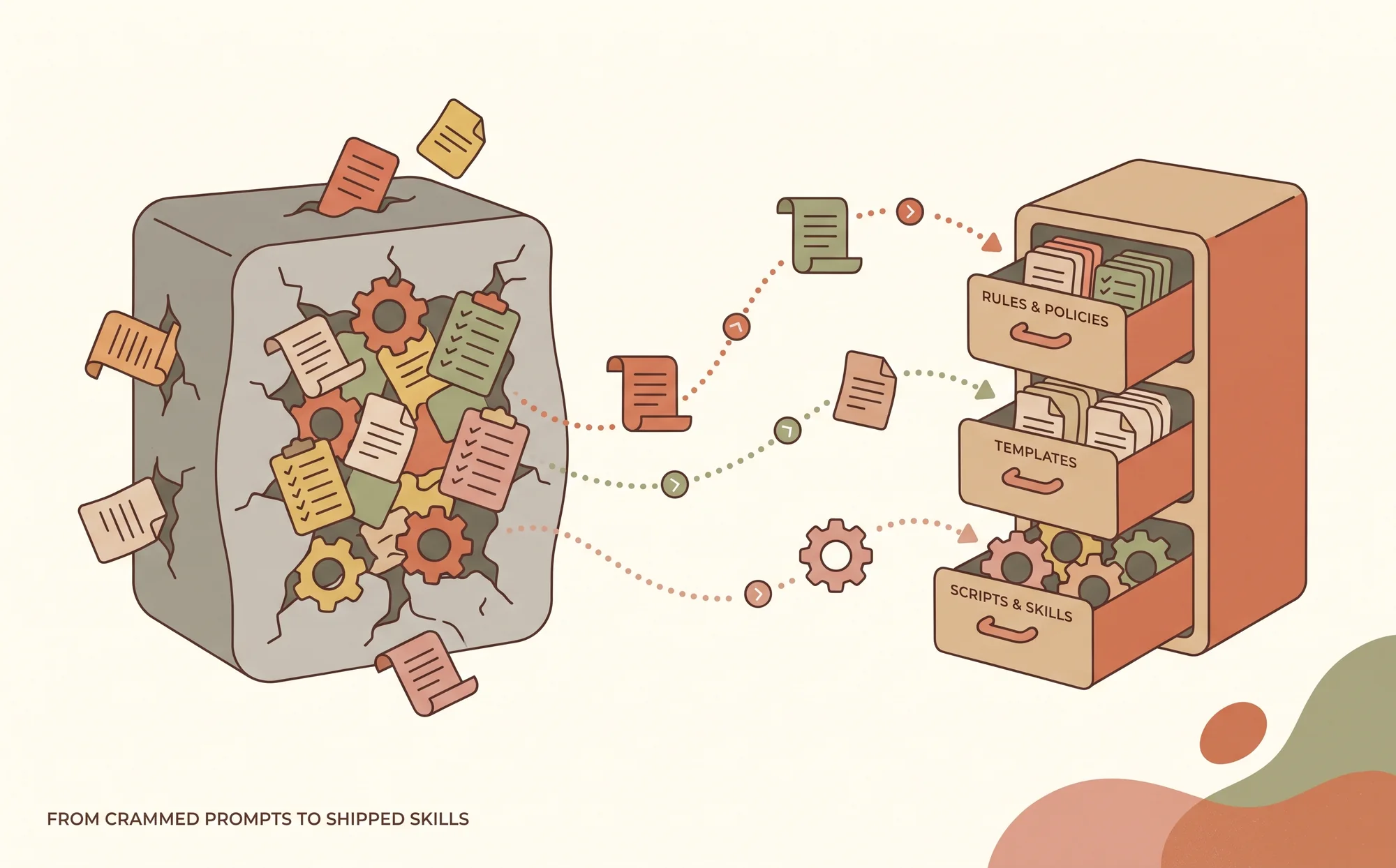
Monolithic system prompts that stuff every policy into context. Expensive, brittle, and almost impossible to audit. You end up with a 30,000-token prompt and no clear answer to the question that actually matters: which version of this policy was used for that decision?
Hardcoded workflows — the world of RPA bots and rigid BPM platforms. Precise, fast, and adaptive to exactly zero new situations. The long tail eats them alive.
Skills sit between the two. Governed enough to audit, flexible enough to handle the long tail of real situations. You version them, sign them, and register them per tenant. The agent discovers the right one at runtime.
This is also where most enterprise AI governance conversations go sideways. Teams ask "how do we control what the model does?" and build layers of runtime filters. The better question is how do we control what the model reaches for? That's the Skill registry. A curated library of governed procedural knowledge. The model is free to reason. It just isn't free to improvise its way into something your compliance team would have stopped.
The point
Claude's Agent Skills happened to ship as a developer tool. The underlying pattern is much bigger. It's a new layer in the enterprise AI stack, sitting above the database and below the agent.
The companies that figure out how to productize Skills well will have a genuine moat, because Skills are the operating procedures of the business, expressed in a form AI can execute. The ones that don't will keep writing 30,000-token system prompts and wondering why compliance keeps finding problems.
Skills aren't a feature. They're infrastructure. The enterprise AI teams that treat them that way will ship faster, govern better, and sleep better than the ones who don't.
The pattern fits more places than the ones above. Our next post applies it where the payoff is harder to ignore — and where most teams already have the raw material without realising it. Worth a read when it lands.
At Atharvix, we spend a lot of time on this layer because it's where most of the practical wins in enterprise AI actually land. If you're designing agent-driven workflows in your CRM, ERP, commerce stack, or custom internal platforms, and trying to figure out how to structure the domain knowledge they need, talk to our team.